
Restrained Joint Ductile Iron Pipe Explained for Engineers and Contractors
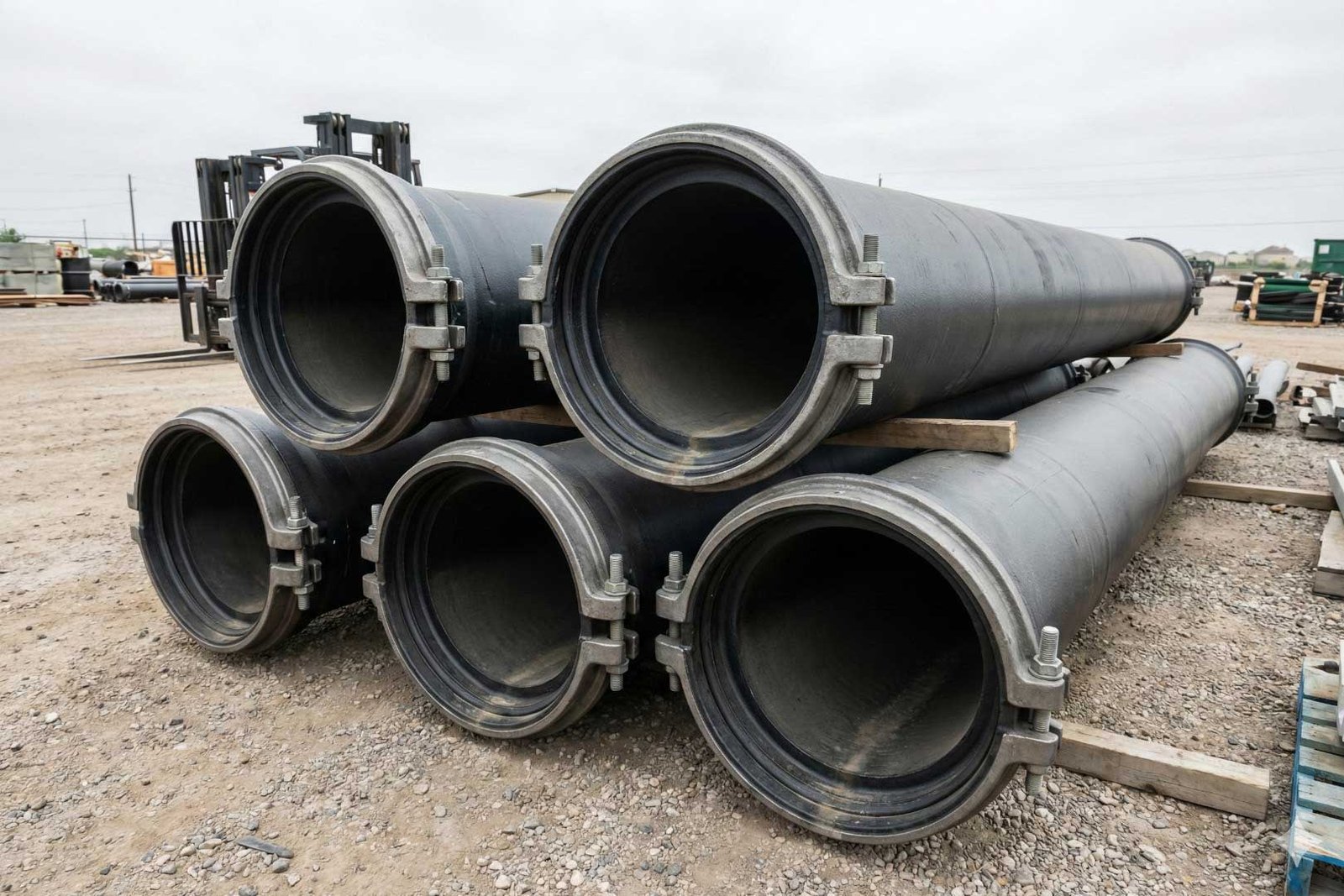
A restrained joint ductile iron pipe is a powerful piping system in which the pipe sections do not get separated under axial forces. The system benefits from joints that incorporate mechanical locking features, including rings, glands, etc. Restrained joint ductile iron pipe plays a crucial role, specifically in pressurized pipelines. Internal pressure, such as thrust forces at bends or dead ends, only requires proper restraint to stop unless it leads to leaks or failures.
In this comprehensive guide, we aim to explain how restrained joint systems work, what the main types, benefits, and applications are, and tell you how to install them step by step.

Types of Ductile Iron Pipe Joints: Unrestrained & Restrained Options
Several types of joints can come with ductile iron pipes, including unrestrained and restrained. Each offers unique features and fits a specific project. Let’s explore the types of ductile iron pipe joints and compare them to help you pick the right one.
Push-On (Unrestrained) Joints
The quickest joints are push-on joints during installation. You lubricate the spigot end, push it into the bell, and the rubber gasket seals tightly. That’s why the contractors usually prefer this one. Push-on unrestrained joints are especially beneficial for many buried lines. According to DIPRA, these joints allow 3-5° of flexibility.
Remember: Push-on joints may not be resistant to axial forces and require thrust blocks.
Mechanical Joints
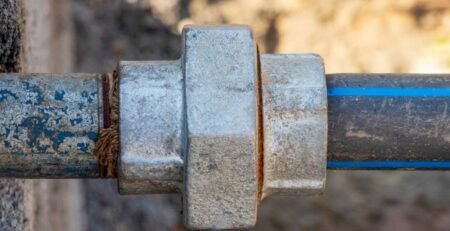
Mechanical joints connect with bolts, a gland, and a gasket. You can simply choose them for fittings, valves, and hydrants. You will find mechanical joints unrestrained in their standard forms. However, they can become retrained using retainer glands. They allow easy disassembly and work well in different soil conditions.
Flanged Joints
Flanged joints bolt two flanges together. Teams use them mostly aboveground, such as at pump stations or treatment plants. They create strong connections that are resistant to leakage. However, they offer little flexibility or deflection. That’s why you rarely see them in pressurized lines.
Restrained Joints
These joints are at the top of the list for fully restrained pipe systems. You can rest assured that the pipes won’t pull apart in case of thrust forces, as the restricted joints include built-in locking features. You can install them very quickly and fit perfectly in high-pressure water and wastewater projects.
This table compares the main joint types side by side:
| Joint Type | Installation Speed | Thrust Restraint | Deflection Allowed | Typical Use Location | Common Applications | Need for Thrust Blocks |
|---|---|---|---|---|---|---|
| Push-On (Unrestrained) | Very Fast | None | Yes (3-5°) | Buried pipelines | Straight runs, low-thrust areas | Yes |
| Mechanical (Standard) | Moderate | None | Limited | Fittings, valves, hydrants | Areas needing future disassembly | Yes |
| Mechanical (with Restraint) | Moderate | Built-in | Limited | Fittings, valves in thrust areas | High-pressure lines needing restraint | No |
| Flanged | Slower | Full (rigid) | None | Aboveground, plants | Pump stations, treatment facilities | No |
| Restrained (Push-On Style) | Fast | Built-in | Yes (3-5°) | Buried pressurized lines | Bends, tees, high-pressure water/wastewater | No |
Thrust Forces in Pipelines: Why They Matter for Restrained Joints
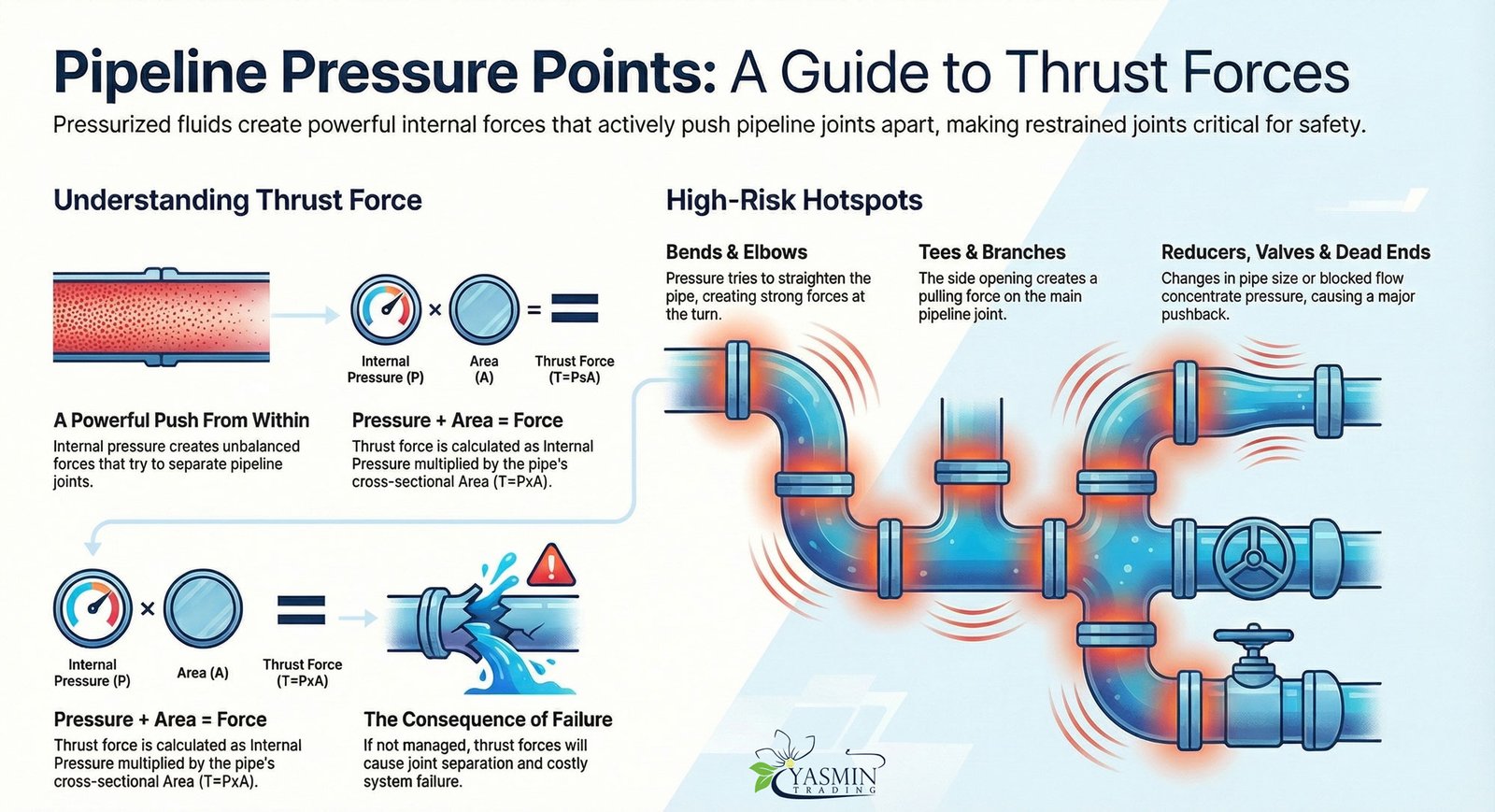
Thrust forces are strong pushes that aim to break apart the joints in a pipeline from the inside. These happen when the axial loads in pressurized systems are not balanced. Think of it like water pressure trying to break the pipeline at weak points, like joints.
How Internal Pressure Creates Axial Loads
Imagine how the water goes through the pipe when there is a lot of pressure. Everything is fine as long as the pipeline is straight. But when we get to the bends or the fittings, the pressure is too much to handle.
So, you really require axial force resistance in these kinds of systems. The stronger the thrust force, the more pressure there is or the bigger the pipe is. The basic formula for thrust force is easy:
T = P × A
- T = Thrust force (in pounds or newtons)
- P = Internal pressure (in psi or bar)
- A = Cross-sectional area of the pipe (inside area where pressure acts)
Where to Expect Thrust Forces
There are various spots in a pipeline that may experience thrust forces, and you must be careful about them (source: ResearchGate):
- Bends and Elbows: Everywhere that pressure tries to straighten and break the pipe.
- Tees and Branches: The side opening pulls on the main pipe joint.
- Reducers: When the pipe gets smaller, the bigger section pushes back on the smaller part.
- Valves: A closed valve blocks flow and builds pressure on one side.
- Dead ends or caps: Pressure has nowhere to go, so it tries to get out.
What Happens If Joints Are Not Restrained?
The joints obviously cannot stand the pressure, and the system fails if they are not restrained. In addition to your system’s failure, you must know that the cost of repair and fixing will be very high as well. As a result, restrained joints are a must in a pressurized pipeline system.
How the Restrained Joint Ductile Iron Pipe Works
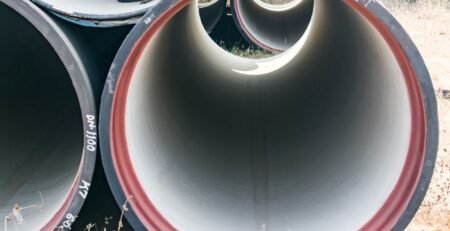
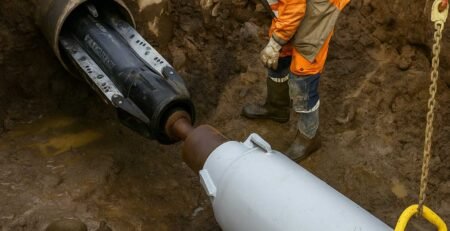
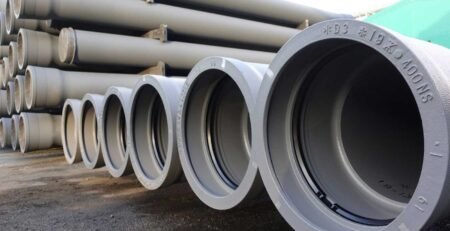
Restrained joint ductile iron pipes use a very simple system: bell-and-spigot. This helps the whole system fight thrust forces more efficiently by adding locking features. Let’s see what we find in a restrained joint ductile iron pipe:
- Every pipe has a plain end called the spigot.
- The other end is wider and called the bell.
- You connect pipes by pushing the spigot of one pipe into the bell of the next.
Inside the bell is a rubber gasket. The gasket squeezes tight and makes a seal when the spigot slips in. The real key with these kinds of pipelines is the built-in locks, which can be clamps, rings, or metal teeth. They hold the spigot securely as you put the junction together. These locks keep the spigot from moving.
The locks keep the pressure in check when thrust forces try to break the pipes. They safely move the force from one pipe to another. This makes the whole pipeline into one robust, connected chain that stays together even when there is pressure.
Restrained vs Unrestrained Joints: Side-by-Side Comparison
You, as an engineer or contractor, must know the differences between restrained and unrestrained joints to pick the right one. Below, we will note the main differences between them:
Structural Behavior
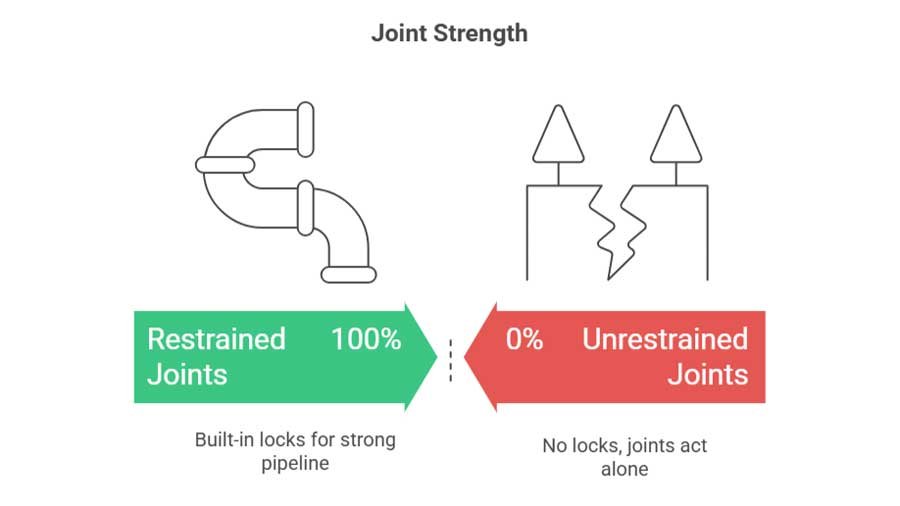
Unrestrained joints still need a rubber gasket for a seal. But they have no lock. Each joint acts alone. Thrust forces push against one joint at a time and can pull the spigot out of the bell.
Restrained joints have built-in locks that hold pipes together like a chain. Thrust forces push several pipes simultaneously. This will help the whole pipeline remain strong.
Risks of Unrestrained Joints
Unrestrained joints perform best in straight lines. They can break apart during tests or surges near bends, tees, valves, or dead ends, leading to leaks, floods, damage, and expensive repairs.
When Restraint Is Needed
As noted in EBAA Iron, att bends, tees, reducers, valves, hydrants, dead ends, steep slopes, bad soil, and high-pressure or surge lines, you must be careful. There, a restrained joint ductile iron pipe is the safest choice.
What Are Different Types of Restrained Joint Systems
Restrained joint ductile iron pipes are found in several types. Each one uses a different way to lock the joint while keeping the basic connection. Here’s a closer look at the main kinds:
Push-On Restrained Joints
Push-on restrained joints work with the same simple mechanism we mentioned earlier. The spigot end slides into the bell end, and a built-in locking mechanism engages right away. A rubber gasket seals the connection tightly, while locking segments or rings hold the spigot to stop pull-out. These joints provide excellent security and long-term reliability. Check more features as follows:
Applications: Buried water mains, wastewater force mains, long straight runs, and most municipal projects.
Advantages: Fastest installation, lower labor cost, works in tight trenches.
Limitations: Harder to disassemble later, some brands have pressure limits.
Mechanical Joint Restraints
Mechanical joints are another popular type of restrained joint system. They start with the standard mechanical joint setup, but add retainer glands or wedges that are used for restraint.
The spigot end goes into the bell end just like other types. Bolts tighten the gland and compress the rubber gasket for a solid seal. The extra restraint parts give good resistance against high internal pressure and temperature changes. These joints create a durable and really restrained system. Wonder where to use them and what the limitations are?
Applications: Fittings, valves, hydrants, tees, and transitions to other pipe materials.
Advantages: Easy to disassemble for future repair and maintenance, widely available parts.
Limitations: Takes longer to install due to bolting, needs wrench space in the trench.
Fully Restrained / Locking Joint Systems
Fully restrained or locking joint systems are the strongest against long-term forces and thrust. It differs in assembly compared to other types. The welded or special lock gives super reliable fittings that take extreme loads without problem. The whole pipeline becomes one solid, fully restrained chain. Let’s see what this system is used for and the advantages it offers:
Applications: High-pressure lines, industrial piping, trenchless installs, surge-prone systems, or areas with very high thrust.
Advantages: Maximum strength and axial force resistance, great for large diameters or tough conditions.
Limitations: Requires skilled human resources and tools (welders or special tools), little or no flexibility in some designs, higher cost, and no easy disassembly.
Restrained Joints vs Thrust Blocks: Which Is Better?
Most pressurized pipelines need something to prevent thrust forces from tearing the pipes apart (source: ScienceDirect). Concrete thrust blocks and restrained joints are the top picks for many projects. Here’s an easy comparison to help you pick the right one.
A thrust block is a big chunk of concrete poured behind a bend, tee, valve, or dead end. When pressure inside the pipe creates thrust, the fitting pushes against the concrete. The concrete pushes against the soil in the trench wall. The soil pushes back and holds everything in place.
Now, let’s have a side-by-side comparison to help you choose the right one:
Space Needed
Thrust blocks require a lot of room. You need a wide trench and a clear space behind the fitting to pour the concrete. So, when you don’t have enough space, such as on city streets or in narrow spots, this can be a real problem.
Restrained joints need almost no extra space. The lock is inside the pipe joint. The only thing you need is to assemble everything as usual.
Soil Requirements
Thrust blocks only work if the soil is strong and solid. Soft, wet, or loose soil won’t be appropriate for such joints at all. You are suddenly stuck in building bigger blocks and finally have to find another way.
Restrained joints have nothing to do with the soil. The hard work is for the locks inside the joint to be done. These joints are good for the poorest soil.
Installation
Thrust blocks take time. The process is not only too long to be done by the crew, but the rain or cold weather will stop the installation.
On the other hand, the installation process for restrained joints is shorter. You just put them together like a normal pipe and don’t have to wait for concrete.
Long-Term Reliability
Thrust blocks look appropriate at the beginning. But over time, nearby digging, soil settling, or erosion will result in their destruction. The block might crack or shift years ahead.
Restrained joints stay strong for decades. The metal locks don’t wear out and don’t depend on perfect soil forever.
| Aspect | Thrust Blocks | Restrained Joints | Winner | Why? |
|---|---|---|---|---|
| Space Needed | Wide trench + clear area | No extra space | Restrained | Fits tight urban trenches |
| Soil Requirements | Needs strong/stable soil | Works in poor soil | Restrained | Locks handle thrust, not soil |
| Installation | Slow (pour, cure 2-7 days) | Fast (minutes per joint) | Restrained | No weather delays, less labor |
| Long-Term Reliability | Weakens (erosion, cracks) | Strong for 50+ years | Restrained | Mechanical locks don’t depend on soil |
When Thrust Blocks May Still Be Acceptable
Thrust blocks still make sense in some situations and projects, including:
- Very large pipe diameters (restrained options are costly)
- Short, low-pressure lines with a lot of room and good soil
- Temporary lines or quick repairs (speed is not important)
- Projects that need unrestrained joints, rule-wise
Engineering Design Considerations for Restrained Joint Ductile Iron Pipe
You are responsible for your project and must keep the pipeline safe. So, consider the following points and plan in a good way:
- Required restrained length: You only restrain pipes near fittings. The pressure, pipe size, bend angle, and soil type decide how long the pipeline must be. Good soil shortens it.
- Pressure and surge considerations: Consider the highest pressure at the time of calculation. Surges make the normal thrust twice more.
- Safety factors: Add extra strength, usually 1.5 to 2 times the calculated thrust. Then you won’t be surprised by errors.
- Pipe size and wall thickness: Bigger pipes make a lot more thrust. Thicker walls make the pipe heavier, which helps a little with soil friction.
Soil-Pipe Interaction in Restrained Joint Design
Soil plays a vital role in the restrained joint resistance against the thrust forces. It remains the pipe tightly in place, and as a result, you will need fewer locked joints. Soil types are effective in the results as well. For instance, sand creates the best friction, while clay lessens it. According to TxDot Research Library, tightly packed backfill (95% or more) increases friction and stability. Loose backfill lets the pipe move more easily.
Generally speaking, soil is one of those important matters that affect the restrained joint ductile iron pipe efficiency and safety.
Joint Deflection and Alignment in Restrained Systems
Restrained joints let the pipes deflect to a restricted extent (usually 3-5 degrees per joint) to match the curves or ground settling. Too much deflection puts the gasket and locks under excessive stress and will result in leaks or failure. Always be careful about manufacturer limits.
Moreover, proper alignment is a must during the installation process. Poor alignment means broken gaskets, weakened locks, and uneven stress. Make sure the assembly is straight and tight.
How to Install Restrained Joint Ductile Iron Pipes?
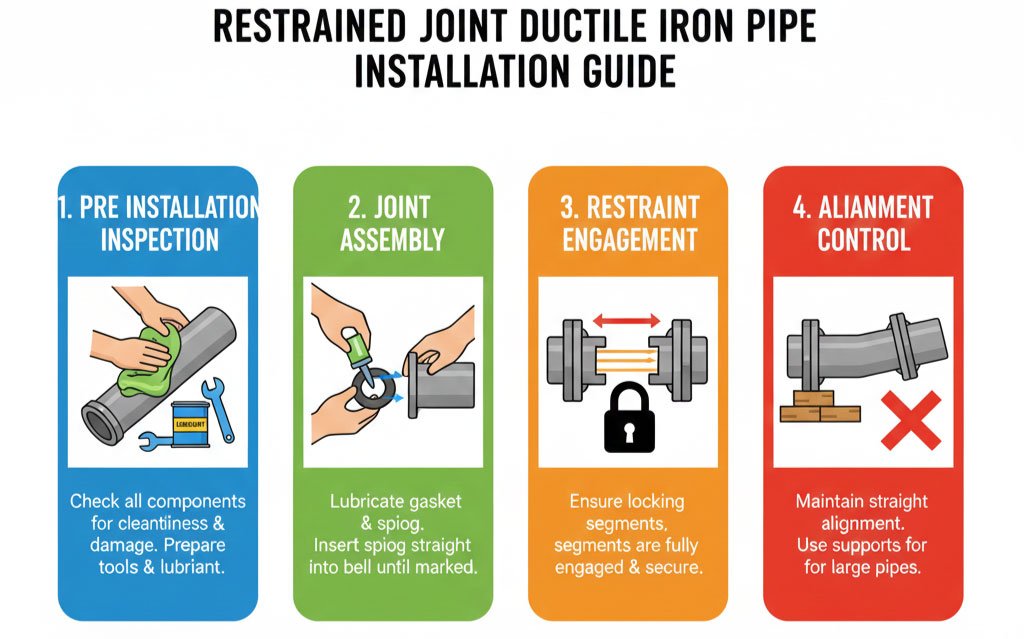
Restrained joint ductile iron pipe installation requires a few simple yet vital steps. These steps must be done carefully and precisely. If so, achieving a secure and durable piping system is assured. The proper step-by-step guide is as follows:
- Pre-installation inspection: Keep an eye on everything. All pieces must always be clean and not damaged. Keep the maintenance tools and lubricant ready.
- Joint assembly: Lubricate the gasket and spigot. Push the spigot straight into the bell until it reaches the mark. You will have a tight seal in this way.
- Restraint engagement: Locks start working as you assemble. Make sure they are locked fully.
- Alignment control: Keep the spigot straight into the bell. There must be no angles. Use supports on large pipes to prevent damage.
Inspection and Testing for Restrained Joint Ductile Iron Pipe
Now that you have installed the whole system successfully, you must inspect everything and keep testing to ensure there are no obstacles. If you want the pipeline work safely, do not forget the following steps:
Visual inspection
Have a look at the joints carefully. All the segments must be in their own place and fully aligned. Look for any damage and dirt that may interrupt the system’s proper work. Keep the angle within the suggested amount.
Restraint verification
The locking mechanism is very important. Do they work properly and get locked fully? The reference marks are obvious in the push on restrained joints. In mechanical joints, you can check that bolts are torqued to spec. Some systems offer test features to make sure everything is right.
Hydrostatic pressure testing
Fill the line with water, remove air, and raise pressure slowly to the test level. Keep testing until the standard time (often 2 hours). Do the joints move? Does the pressure drop? Are there any leaks? See how the restraints work under real pressure.
Common Mistakes in Restrained Joints Design and Installation
When installing and designing the restrained joint ductile iron pipe, all steps must be done mistake-free, or you will experience various issues, including leakage. Below are the most common errors that contractors may make, and you must avoid them:
- Insufficient restrained length: You do not lock enough pipes, and the thrust forces destroy everything.
- Wrong restraint selection: You pick a type that can’t handle the pressure or job, and it does not have the required resistance.
- Poor soil assumptions: You think the soil is strong enough, and do not consider a proper length.
- Excessive deflection: You bend the joint too much and not within the standard limitations. They pull apart soon.
When Do Professionals Use Restrained Joint Ductile Iron Pipes?
Restrained joint ductile iron pipes are typically the perfect choice for professionals. The reason that this type of joint is popular was just mentioned above. However, the applications of these restrained joints are in several forms. The most essential ones are listed below.
Water distribution
The fittings used for the water distribution system must be totally resistant to pressure. Being leak-proof is also essential for such fittings. This is why professionals mainly use restrained joint ductile iron pipes for water mains.
Fire protection
Restrained joint ductile iron pipes are perfect for application in fire suppression systems. The reason is that they show proper strength and have internal pressure resistance. They can tolerate the hardest situations, and that’s why you can use them in fire protection systems as well.
Wastewater force mains
The restrained joints provide a leak-proof connection. This is a vital factor in sewage systems everywhere. Corrosion resistance is also a primary feature that the piping system for sewage must contain, and restrained joint ductile iron pipes offer it.
Pump stations
Pump stations face frequent pressure surges, vibrations, and high flows. Restrained joint ductile iron pipes keep joints tight around pumps and valves. They don’t separate under tough conditions and remain strong in their own place.
Urban / space-restricted projects
In crowded cities or narrow trenches, you can not use large concrete thrust blocks as there is insufficient room for them. That’s when the restrained joint ductile iron pipes come to your aid. They need almost no extra space and install faster. They are really helpful and ideal for such projects.
| Application | Key Requirements | Why Restrained Joints Fit | Typical Use Case |
|---|---|---|---|
| Water distribution | High pressure resistance, leak-proof | Totally resistant to pressure, fully leak-proof | Water mains |
| Fire protection | Strength, internal pressure resistance | Proper strength, handles extreme situations | Fire suppression systems |
| Wastewater force mains | Leak-proof, corrosion resistance | Leak-proof connection, strong corrosion resistance | Sewage systems |
| Pump stations | Handle surges, vibrations, high flows | Keeps joints tight under tough conditions | Around pumps and valves |
| Urban / space-restricted | Minimal space, fast install | No extra space needed, installs faster | Crowded cities, narrow trenches |
Advantages and Limitations of Restrained Joint Ductile Iron Pipe
There are several advantages to restrained joint ductile iron pipes. Despite all these benefits, you may encounter some limitations as well. We will consider both advantages and limitations as follows:
Advantages:
- High durability: As these types of joints can perfectly endure wear and tear, they offer a long-lasting service life.
- Flexibility: They have no problem moving, especially due to thermal changes, such as contraction or expansion.
- Internal pressure resistance: Internal loads that are within the piping system are resisted perfectly due to the built-in restraint system.
- External loads resistance: Soil or the above vehicle loads are highly endured as these joints are highly resistant to external loads.
- Cost efficiency: They offer a cost-saving system as they require lower maintenance costs. The long service life is also a significant help in saving expenses.
- Low maintenance: The required maintenance is as low as it gets with restrained joint ductile iron pipes.
Limitations:
- Design precision required: No mistakes are accepted when calculating the restrained length. Even the smallest mistake will lead to the project’s failure.
- Higher upfront cost: Restrained fittings or pipes may cost more than standard unrestrained fittings or pipes.
- Assembly care required: Locks must engage fully. Poor installation means weak joints.
- Limited disassembly: Some types (especially fully locked) are hard or impossible to take apart later.
Wrap-Up
If your pressure lines have bends, tees, valves, dead ends, high pressure, surges, bad soil, steep slopes, or are in a small city, a restrained joint ductile iron pipe is the best option. It is superior to thrust blocks and unrestrained joints since it is easier to assemble, takes up less space, and lasts longer.
To achieve the best results, you need to carefully determine the length of the restraint, considering safety and surges. You also need to choose the suitable restraint, ensure that everything is in the right place and compacted well, and stay within the deflection limits. For decades, it has worked effectively for water mains, wastewater force mains, fire lines, and more when done correctly, without leaking and with minimal maintenance.
Why Choose Us?
With all said, it can be concluded that restrained joint ductile iron pipes are generally the most appropriate option for several different applications. They offer a secure, durable, and reliable connection for various usages. However, there is a wide range of factors and features that might be essential to consider based on your project. To learn more about the information you would require to make the wisest decision, contact our professionals. We will provide you with all the needed information to help you.
FAQs: Restrained Joint Ductile Iron Pipe
1- What is the difference between restrained and unrestrained ductile iron pipe joints?
Unrestrained joints don’t have locks and need thrust blocks, whereas restrained joints have built-in locks that keep them from coming apart when pressure is high.
2- Why are restrained joint ductile iron pipes used in pressurized systems?
They can handle thrust pressure, which keeps the pipeline sturdy and leak-proof around bends, tees, and other vulnerable places even when the pressure is high.
3- How do I install restrained joint ductile iron pipes properly?
Lubricate the gasket and spigot, push them together, lock them in place, and make sure they are lined up for a strong connection.
4- Can restrained joint ductile iron pipes be used in urban or space-restricted areas?
Yes, they don’t take up much area and are great for tight spaces like tiny tunnels or busy cities.



Leave a Reply