

Bitumen Extraction Test: Advantages, Limitations, and Quality Control Role
Highway construction requires durable asphalt infrastructure that comes from a reliable mixture of bitumen and aggregates. After the long-term curing of asphalt, it may show cracks after a winter or a scorching summer. To prevent such dilemmas, engineers utilize the bitumen extraction test, which indicates how much bitumen binds the mixture.
In this article, we’ll clarify this test via standards, requirements, test procedures, calculations, and a reporting format for further testing. In the first section, we examine global standards and guidance for bitumen content measurements.
Global Standards of The Bitumen Extraction Test
To keep the reliability of bitumen content in the mixture, international standards and codes are used to shape the accuracy in asphalt mix testing and laboratory results. Here are the most-used standards, such as ASTM, AASHTO, and IRC SP & IS.
ASTM D2172: This standard represents quantitative asphalt binder test methods that use solvents like trichloroethylene for complete extraction.
AASHTO T164: Focused on binder content test, it clarifies solvent-based extraction for transportation projects that require accurate results.
IRC SP 11-1988 & IS 13826: Indian Roads Congress highlights that this test adapts the bitumen percentage test for local aggregates for recovery protocols.
RHD Standard Test Procedure: designed for tropical climates like Bangladesh, it details the centrifuge extraction method with calibration requirements.
Objectives of the Bitumen Extraction Test
The essence of the bitumen extraction test is on the asphalt quality assurance in road construction for durable performance over decades, with no cracks included.
Measure Bitumen Percentage in Asphalt Mixtures
This test is for indicating the exact bitumen percentage in asphalt mixes, generally between 4-7% in standardized hot mix asphalt (HMA). The correct measurement of bitumen for a reliable pavement prevents cracking from the improper mixture.
Confirm Compliance with Mix Design Specifications
The proper ratio of aggregate binder directly affects design specs and mixture alignments in road construction testing, which can reduce the cost of maintenance.
Recover Bitumen for Property Testing
This test also uses bitumen for further analysis, like penetration, ductility, and viscosity tests that represent aging and performance requirements. The pavement quality control and recycling efforts are covered by the isolation of bitumen.
Tools Required for the Bitumen Extraction Test
The required apparatus for this test includes an oven, an extractor, solvents, and balances to create such authentic results of the extraction test and bitumen content measurement.
- Centrifuge Extractor: Can increase the speed by 3600 rpm with a 1.5 L capacity to separate bitumen from other aggregates via a high RPM centrifuge extraction method.
- Balance: With ±0.01 g accuracy, which indicates the bitumen percentage test through calculation of initial and final weights of samples.
- Oven: Thermostatically controlled ovens that dry aggregates at 105-110°C by raising the temperature up to 250°C.
- Filter Paper Rings: To prevent fine fillers from being released during the centrifuge process and loss of bitumen content.
- Solvents: Trichloroethylene or toluene solvent dissolves bitumen, chosen based on aggregate compatibility.
- Personal Protective Equipment (PPE): Fume hood, gloves, and goggles are used to ensure the safety of hazardous solvents during the extraction procedure.
- Funnels, Beakers, and Cylinders: During the cold solvent extraction, there may be found some tools that handle them with the least risk.
| Apparatus | Specification | Purpose in Test |
|---|---|---|
| Centrifuge Extractor | 1.5 L, 3600 rpm | Separates bitumen via centrifuge extraction method |
| Balance | ±0.01 g accuracy | Measures weights for bitumen percentage test |
| Oven | Up to 250°C, 105–110°C drying | Dries aggregates for accurate results |
| Graduated Cylinders, etc. | Solvent-resistant materials | Handles solvents and effluents |
| Filter Paper Rings | High-retention capacity | Captures fillers in binder content test |
| Solvents | Trichloroethylene or toluene | Dissolves bitumen for extraction |
| PPE | Gloves, goggles, fume hood | Ensures safety during asphalt extraction procedure |
Sampling and Preparation for the Bitumen Extraction Test
The bitumen extraction test starts with collecting the sample from each batch and preparing it for weighing. This section provides tips for the initial step of this test.
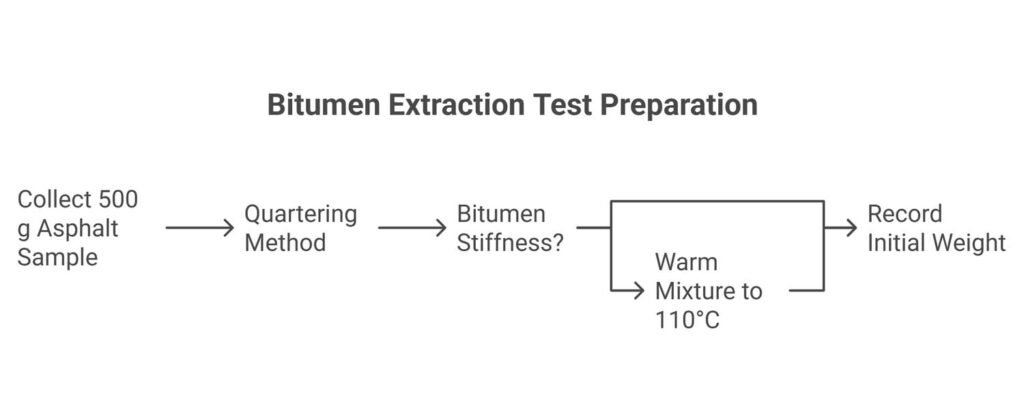
First, obtain a 500 g sample of asphalt from each batch or core to extend the results to the entire mixture. The quartering method can be used to improve uniformity in bitumen content data.
Second, if the stiffness of bitumen causes trouble, warming the mixture to 110°C can ease the process with no change in bitumen content. (Source: Scribd)
Last, the initial weight record with ±0.01 g accuracy is used as a base for binder content test calculations.
Test Procedure for the Bitumen Extraction Test
The isolation and quantification of bitumen content in asphalt mixture uses a method including two main steps: extraction and drying and weighing phase to reach accuracy in results.
1. Extraction Phase
This phase contains several steps, from placing the collected sample in a centrifuge bowl to adding solvent, collecting residues, and washing the section for the preparation of the drying step.
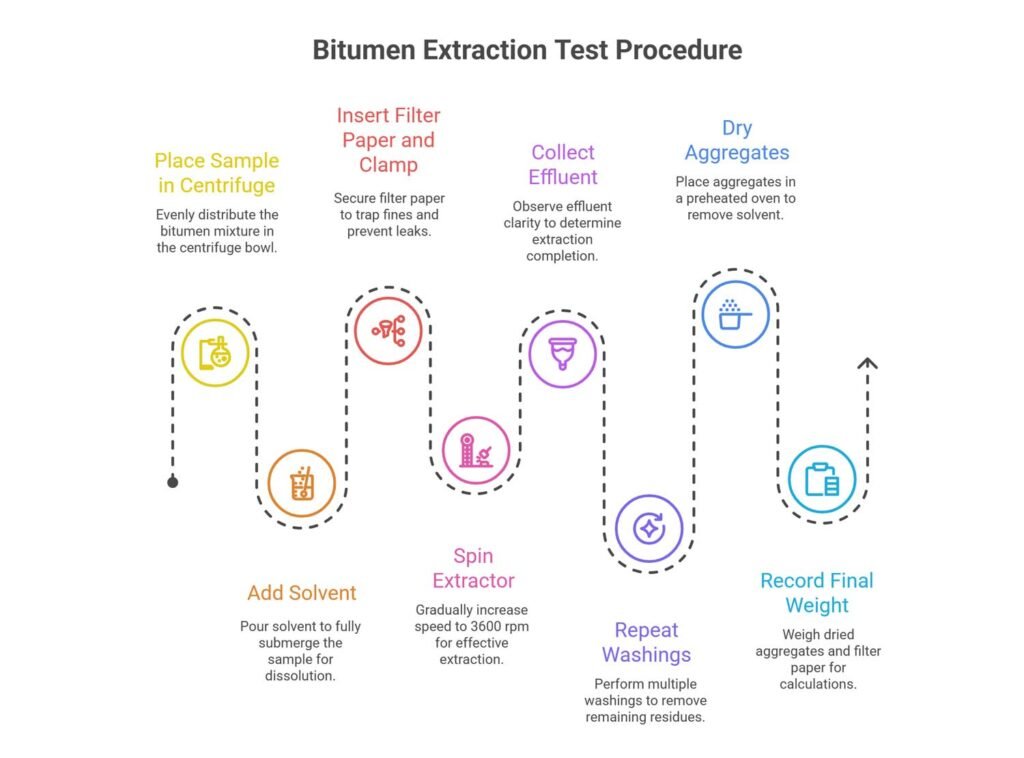
Placing a Sample in the Centrifuge
As noted in Testbook, use a centrifuge extractor bowl for 500 g of bitumen mixture, and consider that the distribution should be even in this method.
Adding the Solvent
Pour trichloroethylene or toluene solvent until the sample fully submerges, which eases the bitumen dissolution process.
Insert Filter Paper and Clamp
To trap the released fines, put a filter paper ring and clamp the cover to avoid any further leaks in the test.
The Spin Extractor
Start the extractor slowly and increase its speed to about 3600 rpm. This guarantees effective extraction when using cold solvents.
Effluent Collection
The bitumen separation is almost complete when the effluent (solvent-bitumen mixture) runs virtually clear.
How Many Times of Washings Are Required?
Repeat the washing sections for an accurate extraction in the bitumen percentage test with solvent to reduce the remaining available residues.
1. Drying and Weighing Phase
When the residue is deleted, it’s time to dry aggregates to prepare them for final weight reports and following calculations.
Drying
Place the filter paper and aggregate in an oven that is preheated to 105 to 110 degrees Celsius. To get rid of any remaining solvent, dry until the mass is constant, which usually takes 1-2 hours.
Final Weight Recording
For precise asphalt binder test calculations, weigh the dried aggregate (W2) and filter paper (D), noting the initial weight of the filter paper (B).
Calculation Section of Bitumen Extraction Test
All those measurements in the last section go through calculations, and the main formula for the final result of the extraction test. Here is the formula, notations, and an example of how this formula works.
Bitumen Content (%) = [(W1 − (W2 + W3)) / W1] × 100
Where:
- W1: Initial weight of the asphalt sample before extraction.
- W2: Weight of dried aggregate after extraction.
- W3: Filler retained, calculated as W3 = D − B
- B: Initial weight of the filter paper before centrifugation.
- D: Final weight of the filter paper after extraction, including retained fines.
Consideration: all are measured in grams.
Example Calculation
For a sample with W1 = 1000 g, W2 = 940 g, B = 10 g, and D = 15 g:
W3 = D − B = 15 − 10 = 5 g
Bitumen Content (%) = [(1000 − (940 + 5)) / 1000] × 100 = [(1000 − 945) / 1000] × 100 = 5.5%
Precautions and Safety for the Bitumen Extraction Test
Safety measures protect technicians and maintain accuracy in the bitumen extraction test during asphalt mix testing. These tips reduce risks in pavement quality control for reliable outcomes.
- Wear Solvent-Resistant PPE: Use nitrile gloves and safety goggles to shield against trichloroethylene or toluene solvent exposure, to avoid any probable eye or hand irritation.
- Use Ventilated Area: Perform the asphalt extraction procedure in a fume hood or well-ventilated space to avoid toxic solvent vapor inhalation for a safe lab.
- Avoid Open Flames: Keep flammable solvents like toluene away from sparks or flames to prevent fires that’s important for safe cold solvent extraction.
- Balance Centrifuge: the centrifuge extraction method equipment must be balanced before the main operation to avoid vibrations or damage for the right bitumen percentage test results.
Calibration And Quality Control Considerations
For pavement quality control, careful calibration keeps equipment in top shape so that bitumen content tests give the right results. The RHD Manual is the best way to test the reliability of asphalt mixes.
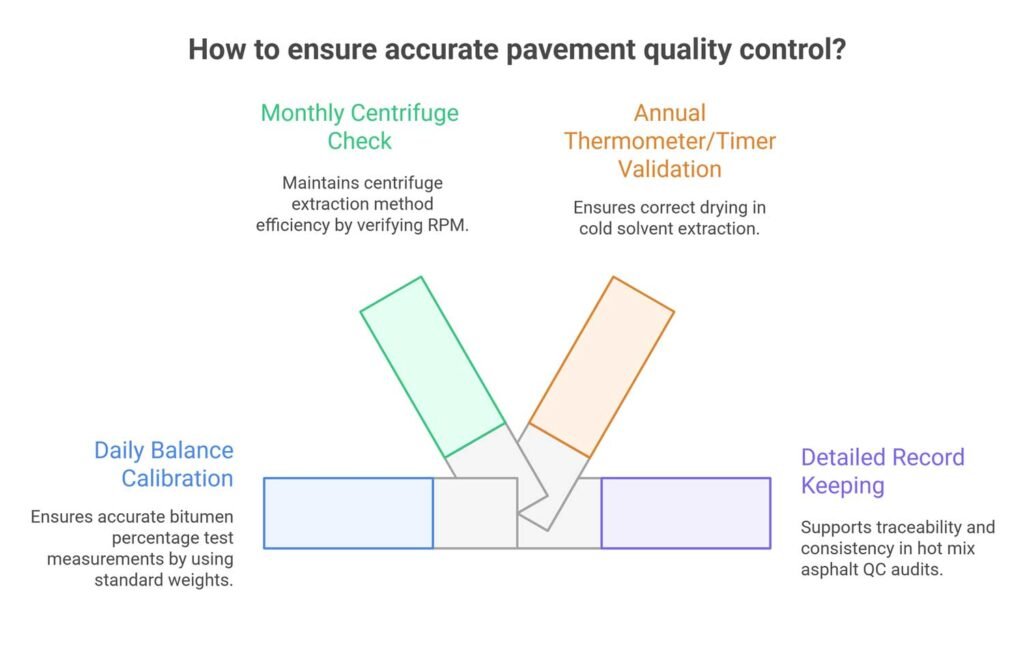
1. Checks on the balance every day
To make sure the bitumen percentage test measurements are correct, calibrate the balance every day with standard weights that are accurate to within 0.01 g. This stops mistakes in the calculations for the binder content test.
2. Monthly Tune-Up for the Centrifuge
To keep the centrifuge extraction method working well, check the RPM of the centrifuge (3600) once a month. Changes can change the results of asphalt binder tests by up to 0.3%.
3. Annual Validation of Thermometers and Timers
Every year, calibrate your thermometers and timers to make sure that cold solvent extraction dries correctly.
4. Keep Detailed Records
Keep records of calibration so that you can trace them back, support hot mix asphalt QC audits, and make sure that everything is the same.
What Methods Exist to Replace the Bitumen Extraction Test?
Regarding the beneficial aspects of the bitumen extraction test, there may be safer or quicker methods to replace this method. These are three good ways to test asphalt mix that go well with the standard bitumen extraction test.
Ignition Furnace Method
Gilson highlights that this burns off bitumen at 540°C, which is faster and cleaner than using solvents for a binder content test. It takes 30 to 45 minutes to finish, which is great for busy labs and follows ASTM D6307.
Nuclear Gauge for Asphalt Content
This test uses gamma rays to quickly and safely check the bitumen percentage. It is correct (0.2%) but needs a license.
The Abson Recovery Method
This process distills bitumen after it has been taken out for tests like viscosity, which is great for more in-depth analysis.
Advantages and Limitations of the Bitumen Extraction Test
The bitumen extraction test is used in pavement quality control to ensure the long-term performance of the pavement in harsh conditions. Below, through a table, we represent how this test can affect both positively and negatively.
| Aspect | Advantages | Limitations |
|---|---|---|
| Accuracy | Accurate, standardized (ASTM D2172) | Needs frequent calibration |
| Acceptance | Trusted in pavement quality control | Uses hazardous trichloroethylene solvent |
| Functionality | Permits bitumen recovery for asphalt binder test | Slower than ignition furnace method |
Reporting Format for the Bitumen Extraction Test
Lastly, after calculations, a well-designed report will ease the process of quality control that includes all necessary items, such as lab details, recorded weights, and validation details. Here are the fundamentals of this report and a sample table to show how exactly it’s designed.
Lab/Project Details: Note the lab name, project ID, date, and the operator’s name.
Sample Description: Describe the mix type, its source, and any specific conditions.
Test Method: Shows what code or standard this test follows, such as ASTM D2172 or AASHTO T164.
Weights: Record W1 (sample), W2 (aggregate), B (filter start), and D (filter end).
Binder %: Show the bitumen percentage and, if useful, give a simple example.
Washings: Mention how many washings were carried out during the test.
Deviations: Point out any unusual results or equipment problems.
Verification: Finish with a signature and date to confirm the report.
Below we’re providing you a sample reporting format that can be used in laboratory records and records and quality control documentation for the Bitumen Extraction Test.
| Section | Details |
|---|---|
| Lab/Project | |
| Sample Description | |
| Test Method | |
| Weights (g) | |
| Binder Percentage (%) | |
| Washings | |
| Deviations | |
| Verification |
FAQs
1- What is the purpose of the bitumen extraction test?
The essence of the bitumen extraction test is on the asphalt quality assurance in road construction for durable performance over decades with no cracks included.
2- What percentage of bitumen does the test aim to measure in asphalt mixtures?
This test is for indicating the exact bitumen percentage in asphalt mixes, normally between 4-7% in standardized hot mix asphalt (HMA).
3- What solvents are used in the bitumen extraction test?
Trichloroethylene or toluene solvent dissolves bitumen, chosen based on aggregate compatibility.








Leave a Reply